

Beyond Traditional Diversification
- 5 days ago
- 5 min read
Updated: 3 days ago
Building More Resilient Portfolios in a Changing Correlation Regime
When Traditional Diversification Works and When It Doesn’t
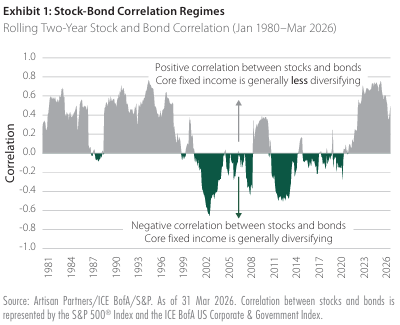
The historical relationship between stocks and bonds is not static.
Many investors have become accustomed to an environment in which bonds can reliably diversify equity risk. During much of the post-2000 period, declining inflation volatility and accommodative monetary policy helped create persistently negative stock-bond correlations. But over longer history, this relationship has varied significantly. The experience of 2022 highlighted the cyclical nature of stock-bond relationships. Faced with an inflation shock and rapid interest rate increases, equities and fixed income sold off simultaneously, undermining the diversification benefits investors had come to expect from a traditional 60/40 portfolio.
Why This Matters for Traditional Portfolios
Rising stock-bond correlations can materially increase portfolio risk.
As stock-bond correlations rise from negative to positive: 1) portfolio volatility increases, 2) drawdowns become larger, 3) bonds become less effective portfolio hedges and 4) investors may need to reduce equity exposure to maintain the same risk profile. Importantly, this dynamic may be particularly relevant in environments characterized by persistent inflation uncertainty, elevated fiscal deficits, rising US Treasury issuance, higher term premium and greater interest rate volatility.
In these regimes, traditional core fixed income may not provide the same diversification benefits investors experienced during disinflationary environments. For allocators seeking to build more resilient portfolios, expanding the opportunity set beyond traditional core bonds may provide additional tools to manage risk and diversify return sources.
Diversification can be regime dependent— correlations work when they work, and don’t when they don’t.
Expanding the Fixed Income Opportunity Set
Today’s fixed income universe is far broader than traditional core bonds.
Many traditional bond allocations remain heavily concentrated in a relatively narrow portion of the investable fixed income universe. Yet today’s global traded fixed income market spans nearly $70 trillion across bank loans, high yield bonds, non-US corporates, emerging market debt, structured credit and global sovereigns. This broader opportunity set may offer investors additional tools to reduce duration sensitivity, access differentiated return streams and improve diversification.

Adding Flexible Global Fixed Income Exposure
Many traditional fixed income allocations remain heavily concentrated in domestic investment grade bonds and benchmark-oriented strategies. While these approaches can serve important portfolio roles, they may offer limited flexibility when interest rate, inflation or policy regimes shift.
Flexible, unconstrained global fixed income approaches seek to expand the opportunity set beyond traditional benchmarks, allowing investors to access a broader range of return drivers across global rates, currencies, sovereign debt and corporate credit markets.
A key advantage of this flexibility is the ability to pursue opportunities in less efficient areas of the market. While many developed market asset classes are heavily researched and actively traded, portions of the global fixed income universe—including segments of emerging market debt—often receive significantly less analyst coverage and investor attention (Exhibit 3). These market inefficiencies may create opportunities for skilled active managers to identify mispriced securities and generate differentiated sources of return.
For investors concerned about the potential limitations of stock-bond diversification in a higher inflation, more volatile macroeconomic environment, flexible global fixed income may provide an additional source of portfolio diversification and resilience.

Artisan Global Unconstrained Strategy
The EMsights Capital Group (one of Artisan Partner’s investment teams) employs a flexible global long/short approach that invests primarily in non-US fixed income securities and currencies, with an emphasis on emerging markets. The approach combines top-down macro analysis with bottom-up fundamental research across sovereign debt, corporate credit, interest rates and currencies. Portfolio construction is driven by risk-factor analysis and implemented through a broad global opportunity set unconstrained by traditional fixed income benchmarks. The resulting portfolio typically reflects a diverse set of exposures across sovereign debt, corporate credit, interest rates and currencies.

Adding Bank Loan Exposure
While unconstrained global fixed income strategies may help investors diversify return sources and reduce reliance on traditional stock-bond relationships, floating rate loans may help address duration risk and enhance income potential.
Floating rate loans may provide a compelling complement to traditional fixed income allocations in higher-rate and more inflation-sensitive environments. Historically, the asset class has combined attractive income generation, limited duration exposure and a relatively consistent return profile. Unlike traditional fixed rate bonds, bank loans have generally been less sensitive to rising interest rates while historically delivering competitive risk-adjusted returns (Exhibit 4).
Bank loans have offered a combination of attractive yields, limited interest-rate sensitivity and more attractive relative valuations versus many other credit sectors (Exhibit 5). At the same time, the structure of the loan market has evolved significantly over the last decade. The market has grown materially larger, while increasing participation from CLOs and private credit vehicles may create periods of forced selling and dislocation that active managers can potentially exploit.

Artisan Credit Opportunities Fund
The Artisan Credit Opportunities Fund is a flexible, credit-intensive investment approach designed to generate attractive risk-adjusted returns. The strategy employs a high-conviction, bottom-up research process to identify opportunities across the corporate capital structure, including bonds, loans, and other securities of leveraged corporate issuers.
By capitalising on market dislocations and special situations, it seeks to exploit the illiquidity premium and asymmetric risk profiles inherent in credit investments. Unconstrained by credit ratings and liquidity, the strategy allows for dynamic rotation of exposures to take advantage of opportunities throughout the credit cycle, aiming for idiosyncratic outcomes less correlated with overall market direction.
To learn more about the strategy, click here.

Figures as at 30 June 2026.
To download the PDF, click here.
This information has been prepared by Artisan Partners for Copia Investment Partners Limited (AFSL 229316, ABN 22 092 872 056) the issuer, distributor and responsible entity of the Artisan Credit Opportunities Fund. This document provides information to help investors and their advisers assess the merits of investing in financial products. We strongly advise investors and their advisers to read information memoranda and product disclosure statements carefully and seek advice from qualified professionals where necessary. The information in this document does not constitute personal advice and does not take into account your personal objectives, financial situation or needs. It is therefore important that if you are considering investing in any financial products and services referred to in this document, you determine whether the relevant investment is suitable for your objectives, financial situation or needs. You should also consider seeking independent advice, particularly on taxation, retirement planning and investment risk tolerance from a suitably qualified professional before making an investment decision. Neither Copia Investment Partners Limited, nor any of our associates, guarantee or underwrite the success of any investments, the achievement of investment objectives, the payment of particular rates of return on investments or the repayment of capital. Copia Investment Partners Limited publishes information on the document that is, to the best of its knowledge, current at the time and Copia is not liable for any direct or indirect losses attributable to omissions from the document, information being out of date, inaccurate, incomplete or deficient in any other way. Investors and their advisers should make their own enquiries before making investment decisions. © 2026 Copia Investment Partners Ltd.


Comments