

Aerospace & Defence: From Cyclical Exposure to Structural Growth
What the start of this decade has made increasingly clear is that today’s global security environment has become more uncertain, and we are living in a more dangerous world than before. Conflicts in Ukraine and Iran, along with broader geopolitical instability, are reinforcing the need for sustained investment in national defence. We believe this represents a shift from episodic spending cycles toward a more durable, multi-year rearmament phase. The question is no longer whether defence spending is increasing, but whether its duration and composition have fundamentally changed.
Historically, defence spending has followed a cyclical pattern, often tied to discrete programs or periods of heightened conflict. Today, however, structural factors are increasingly supporting demand. Governments are not only investing in new capabilities but also rebuilding depleted inventories and maintaining a higher baseline level of readiness. This shift toward replenishment is creating more consistent demand across aerospace and defence, as reflected in the higher baseline of global defence spending in recent years. Notably, this trend extends beyond major powers, with even smaller countries such as New Zealand planning billions of dollars in defence upgrades over the coming years.

Growing defence programs and emerging technologies upend the traditional market
Emerging technologies are reshaping how modern warfare is conducted. Capabilities such as missile defence, advanced sensing, secure communications and counter-drone systems are becoming central to national security strategies. Large-scale, layered defence initiatives are likely to be particularly durable sources of funding. National programs tied to missile defence systems such as “Golden Dome” reflect a growing emphasis on protecting critical infrastructure and populations from increasingly sophisticated threats, with planned spending of $175 billion over three years and potential costs far exceeding this.
These dynamics are supporting sustained investment across multiple areas of the defence supply chain. While large prime contractors remain central to system integration, value is increasingly accruing to companies that provide mission-critical components within these systems. Exposure to areas such as propulsion, sensing and communications can benefit from both rising demand and limited supply, particularly where production capacity is constrained or capabilities are difficult to replicate.
BAE Systems, L3Harriss and RTX illustrate this dynamic. Their exposure to growing areas such as propulsion, tracking and sensing technologies is expanding addressable demand. And capacity constraints in areas such as solid rocket motors can create both volume growth and margin expansion as production capacity is increased. Across the industry, this is reflected in strong order books, growing backlogs and sustained increases in defence budgets.
Beyond defence: Aerospace and the drive for efficiency
After a prolonged downturn, commercial aerospace is in the early stages of its own production recovery, supported by strong travel demand and aging fleets. The introduction of aircraft and engine platforms creates a multi-year opportunity tied not only to original equipment production but also to maintenance, repair and overhaul activity.
At the same time, airlines are increasingly focused on fuel efficiency, driving demand for next-generation engines and components. Higher fuel costs further reinforce this dynamic, increasing the economic incentive to replace older, less efficient engines. The longer oil remains more expensive than it was at the beginning of the year, the greater the incentive for airlines to update their fleets to ever more efficient engines.

This combination of new production and aftermarket demand creates a longer runway for growth across aerospace suppliers, particularly those exposed to engine components and services. In many cases, these businesses benefit from recurring revenue streams tied to installed base, supporting more durable earnings profiles over time. At the same time, the transition to newer aircraft and engine platforms may create some dispersion within the supply chain, benefiting manufacturers of next-generation components while creating headwinds for suppliers tied to older platforms. Across our portfolios, we are invested in companies such as Melrose, Woodward, FTAI and RBC, which we believe are positioned to benefit from a multi-year cycle of aircraft modernization and engine efficiency improvements.
Implications for asset management
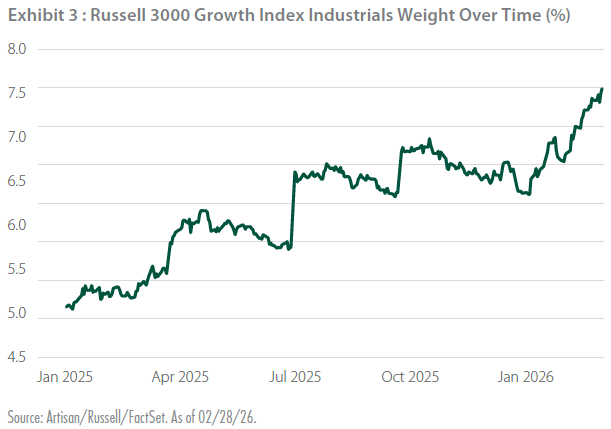
Taken together, these trends suggest a meaningful shift in how aerospace and defence should be viewed from an investment perspective. Historically, these areas—both of which are typically classified as industrials—have typically not been core holdings in growth portfolios, given their cyclical and capital-intensive characteristics. However, as demand becomes increasingly supported by structural drivers, their inclusion within growth portfolios may begin to change. As indicative of this shift, the Russell 3000® Growth Index industrials weight recently crossed 7.5%, a more than 47% increase since January 2025. We believe this marks the early stages of a trend that will last a decade or more.
In our view, the key question is not simply whether aerospace and defence spending is increasing, but rather how its nature is evolving. Companies with exposure to mission-critical components, constrained supply chains and long-cycle aerospace platforms may be particularly well positioned as these industries transition toward more durable growth profiles over the coming decade.
We believe that the growth cycle opportunity in defence transcends the current conflicts in Ukraine and Iran, despite the acceleration in commitments by governments to support these conflicts. NATO’s European members will likely be obligated to meaningfully expand their defence spending over at least the next decade in order to catch up, and as a result, a number of defence-related companies will be well positioned for a long cycle.
To download the PDF, click here.
DISCLAIMER This information has been prepared by Copia Investment Partners Limited (AFSL 229316, ABN 22 092 872 056) the issuer, distributor and responsible entity of the Artisan Global Discovery Fund. This document provides information to help investors and their advisers assess the merits of investing in financial products. We strongly advise investors and their advisers to read information memoranda and product disclosure statements carefully and seek advice from qualified professionals where necessary. The information on this document does not constitute personal advice and does not take into account your personal objectives, financial situation or needs. It is therefore important that if you are considering investing in any financial products and services referred to on this document, you determine whether the relevant investment is suitable for your objectives, financial situation or needs. You should also consider seeking independent advice, particularly on taxation, retirement planning and investment risk tolerance from a suitably qualified professional before making an investment decision. Neither Copia Investment Partners Limited, nor any of our associates, guarantee or underwrite the success of any investments, the achievement of investment objectives, the payment of particular rates of return on investments or the repayment of capital. Copia Investment Partners Limited publishes information on the document that is, to the best of its knowledge, current at the time and Copia is not liable for any direct or indirect losses attributable to omissions from the document, information being out of date, inaccurate, incomplete or deficient in any other way. Investors and their advisers should make their own enquiries before making investment decisions. © 2026 Copia Investment Partners Ltd.
The Artisan Global Discovery Fund invests all or substantially all of its assets in Artisan Global Discovery Fund (Fund), a sub-fund of Artisan Partners Global Funds plc. Artisan Partners Limited Partnership serves as investment manager to the Fund. Artisan Partnership Limited Partnership, its affiliates and Artisan Partners Global Funds plc (together, Artisan Partners) are not affiliated with Copia Investment Partners. Artisan Partners does not take any responsibility for the accuracy or completeness of the contents of these materials, any representations made herein, or the performance of the Artisan Global Discovery Fund offered by Copia Investment Partners. Artisan Partners disclaims any liability for any direct, indirect, consequential or other losses or damages, including loss of profits, incurred by you or by any third party that may arise from any reliance on these materials. Artisan Partners is not responsible for, nor involved in, the marketing, distribution or sales of shares or interests in the Artisan Global Discovery Fund and is not responsible for compliance with any marketing or promotion laws, rules or regulations; and no third party, other than Copia Investment Partners, is authorised to make any statement about any of Artisan Partners’ products or services in connection with any such marketing, distribution or sales. Past performance by any other funds or accounts advised by Artisan Partners, including the Fund into which the Artisan Global Discovery Fund invests, is not indicative of any future performance by the Artisan Global Discovery Fund. © 2026 Artisan Partners. All rights reserved.


Comments